Ways to live
Continuing-Care Communities: One Move, Care That Can Grow
A continuing-care retirement community, often called a CCRC, can be a comforting choice for families who want one move and a plan that can grow with a parent over time. It is still a lifestyle decision first, with neighbors, meals, activities, and less home upkeep, with added support available later if it is needed.
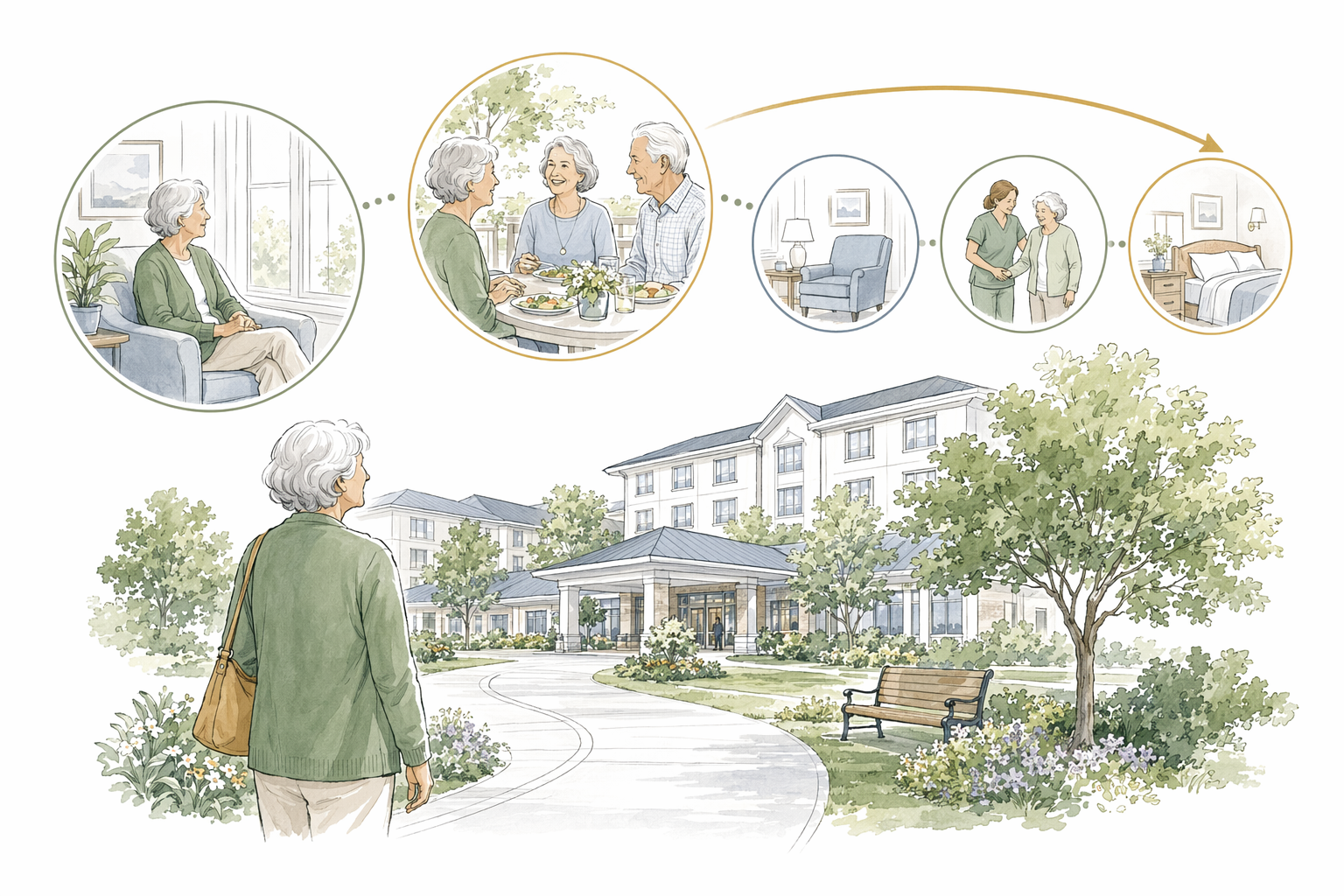
What a continuing-care community is
A continuing-care retirement community brings several levels of living together in one campus or connected community. A parent may start in independent living, which usually means a private apartment or cottage, shared meals, activities, transportation options, and fewer chores. If needed later, the same community may also offer assisted living, which adds help with daily routines like dressing, bathing, and medications, and sometimes memory support or skilled nursing in a separate setting.
For many families, the appeal is simple. Your parent can settle into one community, build routines, make friends, and stay in a familiar place even if life changes. Instead of searching again later, the next level of support may already be part of the plan.
That does not mean every CCRC works the same way. Each one has its own layout, contract options, monthly fees, services, and apartment choices. Some feel like an active apartment community. Others feel more like a small neighborhood with several living options in one place.
- One community, with more than one level of living
- A lifestyle with meals, activities, and less home upkeep
- Often includes independent living, assisted living, and more support if needed later
- A familiar place to stay as needs change

Why families consider a CCRC
Many adult children like the idea of planning ahead without rushing. A CCRC can make that easier. Your parent can choose a community while they are thinking clearly about what kind of home, social life, and daily rhythm they want, not just reacting to a change later.
It can also be a good fit for a parent who values stability. Moving is a big life change. Some people would rather choose one place, learn the hallways, meet neighbors, find favorite activities, and stay rooted there. That sense of familiarity matters.
Families also appreciate the lifestyle side of the decision. Continuing-care communities often offer restaurant-style dining, exercise classes, clubs, outings, housekeeping options, and a calendar of things to do. The goal is not to take away independence. It is to support it, while making everyday life simpler and more connected.
- Plan once instead of starting over later
- Keep familiar neighbors and routines
- Enjoy a social, active community
- Reduce chores like cooking and home maintenance
How the levels of living usually work
Most CCRCs begin with independent living. This is the part many families picture first: a parent has their own apartment or cottage, privacy, and freedom, plus community spaces, dining, events, and optional services. They can come and go, host family, and keep the routines that matter to them.
If more day-to-day help is needed later, a parent may move to assisted living within the same community. Assisted living usually includes the same sense of home and community, plus support with daily activities. Some CCRCs also offer memory support for parents who do best in a setting with more structure, and some include skilled nursing for longer-term support.
The details matter. In some communities, a parent moves to a different building or area when their needs change. In others, more services can be added with less disruption. It is worth asking exactly how transitions happen, what support is available, and whether the community can meet the kinds of changes your family wants to plan for.
If you are still comparing options, our guide to senior living levels can help you see how independent living, assisted living, and continuing-care communities differ.
- Independent living is usually the starting point
- Assisted living adds help with daily routines
- Some communities also include memory support or skilled nursing
- Ask how a move between levels actually happens
How CCRCs are priced
Continuing-care communities often have a different pricing model from stand-alone independent living or assisted living communities. Many charge an entrance fee plus a monthly fee. The entrance fee can be lower or higher depending on the contract, the apartment size, and how the community structures future support. The monthly fee usually covers housing, some meals, activities, maintenance, and other community services.
In broad terms, entrance fees may range from the tens of thousands to several hundred thousand dollars, and in some markets they can be higher. Monthly fees often start around the low thousands per month and can rise significantly depending on the city, the apartment, the level of care, and what is included. If a second person is moving in, pricing may change again.
Some contracts are designed so more future support is included. Others keep the entrance fee lower but charge more later if a parent moves to assisted living or another level. There is no one "normal" contract, which is why families should ask for the pricing structure in plain language.
If you want a first look at monthly ranges in your area, try the cost of senior living estimator. It is a starting point, not a quote, and real numbers depend on the city, apartment, level of care, and what is included.
- Many CCRCs use an entrance fee plus a monthly fee
- Costs vary widely by city, apartment, contract, and services
- Some contracts include more future support than others
- Always ask what is included now and what could cost more later
Questions worth asking on a tour
A tour is not just about the building. It is about whether your parent can picture a good life there. Notice the people. Do residents seem comfortable and engaged? Does the dining room feel welcoming? Are there quiet spaces, outdoor areas, and activities your parent would actually enjoy?
Then ask practical questions. What living options are on campus? How does someone move from independent living to assisted living if needed? Are there different contract types? What services are included in the monthly fee? What tends to cost extra? Can your parent bring their own furniture? Are there language supports or staff who can communicate in your family's preferred language?
You may also want to ask about everyday routines. How are meals handled? Is transportation available? What is the guest policy? How long do residents usually wait for a different apartment size or level of living, if they ever need one? Clear answers can make the choice feel calmer and more grounded.
Our guide to choosing a community can help you compare places in a simple, organized way.
- Ask how transitions between levels really work
- Review contract options in plain language
- Look closely at daily life, not just amenities
- Check for language access and cultural comfort
How Willowbarrow helps
Willowbarrow is a free, multilingual guide and matching service for families looking at senior living options, including continuing-care communities. We are not a senior-living provider, and we are not a government agency. We help families understand the choices, narrow the search, and find communities that may fit their parent's preferences.
Many families have cared for a parent at home first, and that is deeply respected. A CCRC is one good option among several, not the only path. Some families are planning ahead. Others are exploring what kind of community life might feel right in the next chapter.
When you are ready, you can get matched for free. Your family stays in control of the decision. We can help you compare options in a calm, practical way, often in your own language.
- Free matching for families
- Multilingual help is often available
- You choose what feels right for your parent
- Planning ahead is welcome, no pressure
A CCRC lets a parent choose one community now and have support available later, while enjoying a more social, easier daily life.
Common questions
What does CCRC stand for?
CCRC stands for continuing-care retirement community. It usually means one community that offers independent living and additional levels of living, such as assisted living, so a parent can stay in a familiar place as needs change.
Is a CCRC the same as assisted living?
No. Assisted living is one level of living, with help for daily routines. A CCRC is a larger community model that often includes independent living first, then assisted living and sometimes other levels of support as part of the same campus or organization.
Are CCRCs expensive?
They can be, and pricing varies a lot. Many have an entrance fee and a monthly fee, and the real number depends on the city, apartment, contract type, level of care, and what is included.
Does moving to a CCRC mean giving up independence?
Not at all. Many people choose a continuing-care community because they want more freedom from chores, more social connection, and a home that can support them over time. Independent living in a CCRC is still independent living.
Can Willowbarrow help us compare CCRCs near us?
Yes. Willowbarrow is a free matching and guide service that helps families explore options, including continuing-care communities. We help you understand the choices, and your family decides what feels best.