Questions
How big are senior-living apartments?
Senior-living apartments come in many sizes, from simple studios to roomy one- and two-bedroom homes. What matters most is not just the square footage, but whether your parent feels comfortable, independent, and at home there.
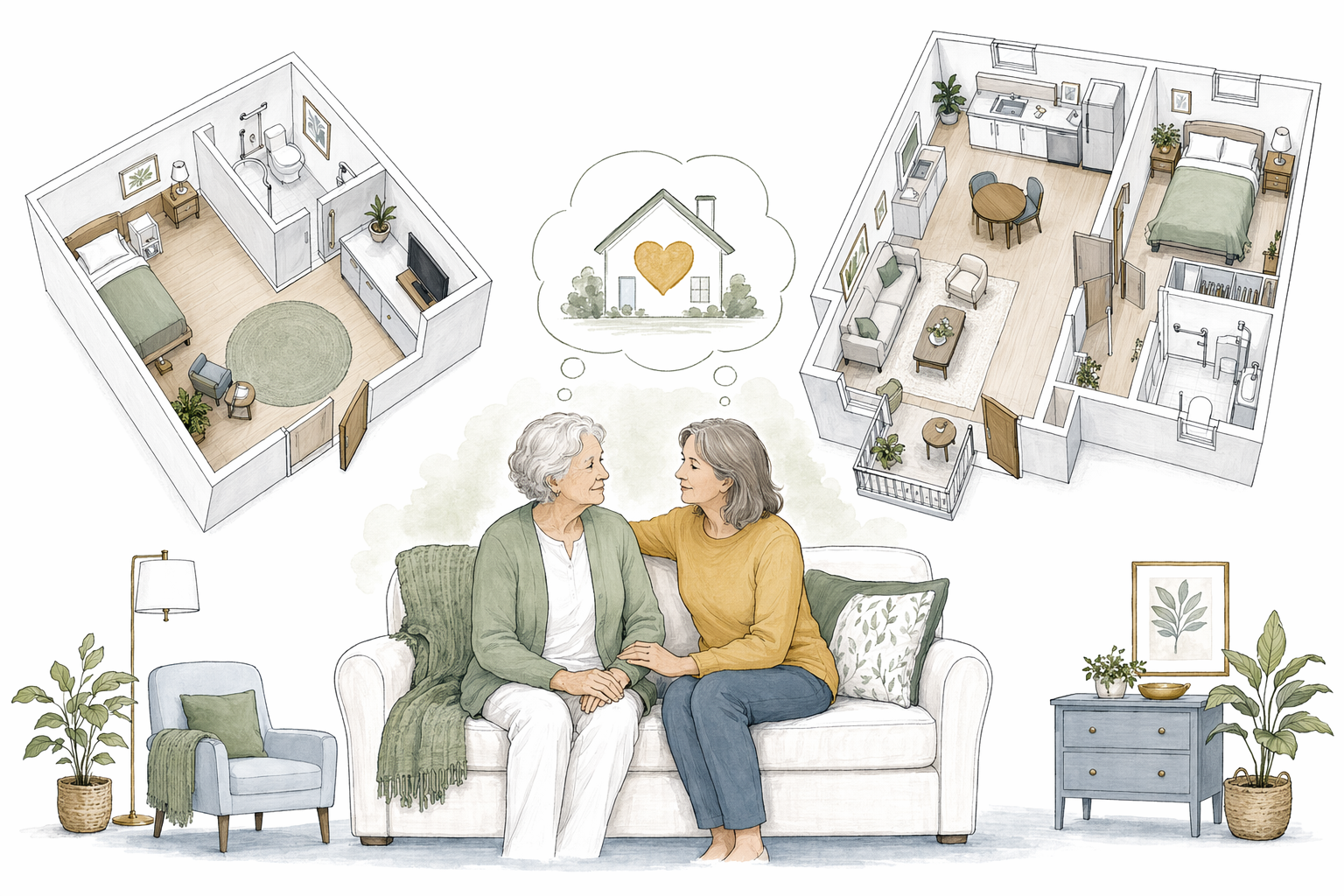
There is no one standard apartment size
Senior-living communities are not all built the same. Some offer cozy studio apartments with a sleeping area, small sitting space, and private bathroom. Others have larger one-bedroom or two-bedroom layouts with a separate living room, kitchenette, and more storage.
In plain terms, many studio and companion-style apartments are on the smaller side, while one-bedroom and two-bedroom apartments give more room to spread out. The real size depends on the city, the building, the age of the community, and the level of living your parent chooses.
If your family is just starting to learn the basics, how senior living works can help you see how apartment styles fit into different community types.
- Studios are usually the smallest option
- One-bedrooms often have a separate bedroom and living area
- Two-bedrooms can work well for a parent who wants more space or regular overnight guests
- Some communities also offer shared suites or companion apartments
The level of living often affects the layout
Apartment size is often tied to the kind of community your parent is considering. In independent living, apartments may feel more like regular retirement apartments, with a bit more room for everyday life, hobbies, and entertaining. These communities focus on lifestyle, with meals, activities, neighbors, and less home upkeep.
In assisted living, apartments are still private homes, but the layout may be a little simpler and easier to move around in. Your parent still has their own space, often with a private bath and room for favorite furniture, plus daily help if needed with things like dressing, bathing, or medications.
Some continuing-care communities offer several apartment styles on one campus, so a parent can choose the setup that fits life now while staying part of the same community over time.
- Independent living often offers the widest range of floor plans
- Assisted living apartments may be designed for simpler daily routines
- Continuing-care communities may have multiple apartment sizes in one place
What usually fits inside a senior-living apartment
Even a smaller apartment can feel comfortable when the space is thoughtfully designed. Many senior-living apartments include a private bathroom, a sleeping area or bedroom, closet space, and room for a small sofa, chair, and table. Some also have a kitchenette with a microwave, mini fridge, or small sink.
Larger apartments may include a full living room, more closet space, a dining nook, or a second bedroom. In some communities, your parent may also have a patio or balcony. The goal is not to recreate a large suburban house. It is to create a home that feels manageable, welcoming, and easy to enjoy.
A good question to ask is not only, "How big is it?" but also, "Will my parent's favorite things fit here and will daily life feel easy?"
- Private bathroom or accessible bath
- Space for a bed, dresser, and comfortable chair
- Room for personal photos, art, and meaningful belongings
- Kitchenette or small kitchen in some layouts
- Closets and storage vary a lot by community
How to tell if the apartment will feel right
Square footage matters, but feel matters too. A bright studio with smart storage can feel better than a larger apartment with an awkward layout. Natural light, window placement, ceiling height, and the distance from the apartment to dining or activity spaces all shape daily life.
Think about your parent's routines. Do they like to read in a quiet corner, host visiting family, keep a small desk, or bring a favorite recliner? Those details help you judge whether a space will support the life they enjoy.
When families get matched, we help them think through these practical questions in a calm, simple way. Willowbarrow is a free matching and guide service, not a senior-living provider, and your family always chooses what feels right.
- Bring a short list of must-have furniture
- Ask about closet and storage space
- Notice the walk from the apartment to meals and activities
- Look at how much natural light comes in
- Ask whether the floor plan is available in more than one size
Cost and apartment size often go together
In many communities, larger apartments cost more than smaller ones, but there is no single national price that fits every place. The real number depends on the city, the apartment size, the level of care or support, and what is included in the monthly rate.
As a general range, independent-living apartments may start around the lower thousands per month in some areas and go much higher in expensive cities or for larger layouts. Assisted-living apartments also vary widely, often from the mid-thousands upward, especially if more daily support is included.
That is why it helps to compare both the apartment and the full lifestyle, including meals, housekeeping, activities, transportation, and any extra services. A smaller apartment in a community your parent enjoys may feel like a better fit than paying more for extra space they do not really use.
- Bigger apartment often means higher monthly cost
- Prices vary by city, apartment type, support level, and included services
- Ask what is included before comparing one community to another
A smaller home can still mean a fuller life
Many families worry that moving from a house to an apartment will feel like giving something up. Sometimes it does mean choosing fewer belongings. But it can also mean gaining something meaningful: more time with neighbors, shared meals, planned activities, less maintenance, and a home that is easier to enjoy.
For many older adults, the apartment is just one part of the experience. The wider community becomes part of home too, including the dining room, garden, activity spaces, library, walking paths, or lounge. That can make a modest apartment feel much bigger in everyday life.
Many families also prefer to care for a parent at home first, and that is deeply respected. Senior living is simply one good option among several. If you want help exploring apartment styles and community types in your language, visit Help or browse living options.
- Less upkeep can create more freedom
- Shared community spaces add to daily life
- The right fit is about comfort, routine, and connection, not just square footage
Senior-living apartments can be small or roomy, and the best one is the one that feels comfortable, easy, and truly like home for your parent.
Common questions
Are senior-living apartments usually smaller than a regular apartment?
Often, yes. Many are designed to be easier to maintain and easier to move around in, but some one-bedroom and two-bedroom layouts can feel quite spacious.
Can my parent bring their own furniture?
Usually, yes. Most communities expect residents to bring favorite furniture and personal items, although how much will fit depends on the floor plan.
Do all apartments have kitchens?
No. Some have full kitchens, some have kitchenettes, and some have only a small food-prep area. It depends on the community and the level of living.
Is a studio too small for senior living?
Not always. For some parents, a studio feels simple, comfortable, and easy to enjoy. The best choice depends on your parent's routines, belongings, and how they like to live.