Questions
What is a continuing-care community (CCRC)?
A continuing-care community, often called a CCRC, is a senior-living community designed for older adults who want a home base for this stage of life, with different levels of support available in one place if needs change over time. For many families, it can offer a reassuring mix of independence, community, and a plan for the future, without taking away choice.
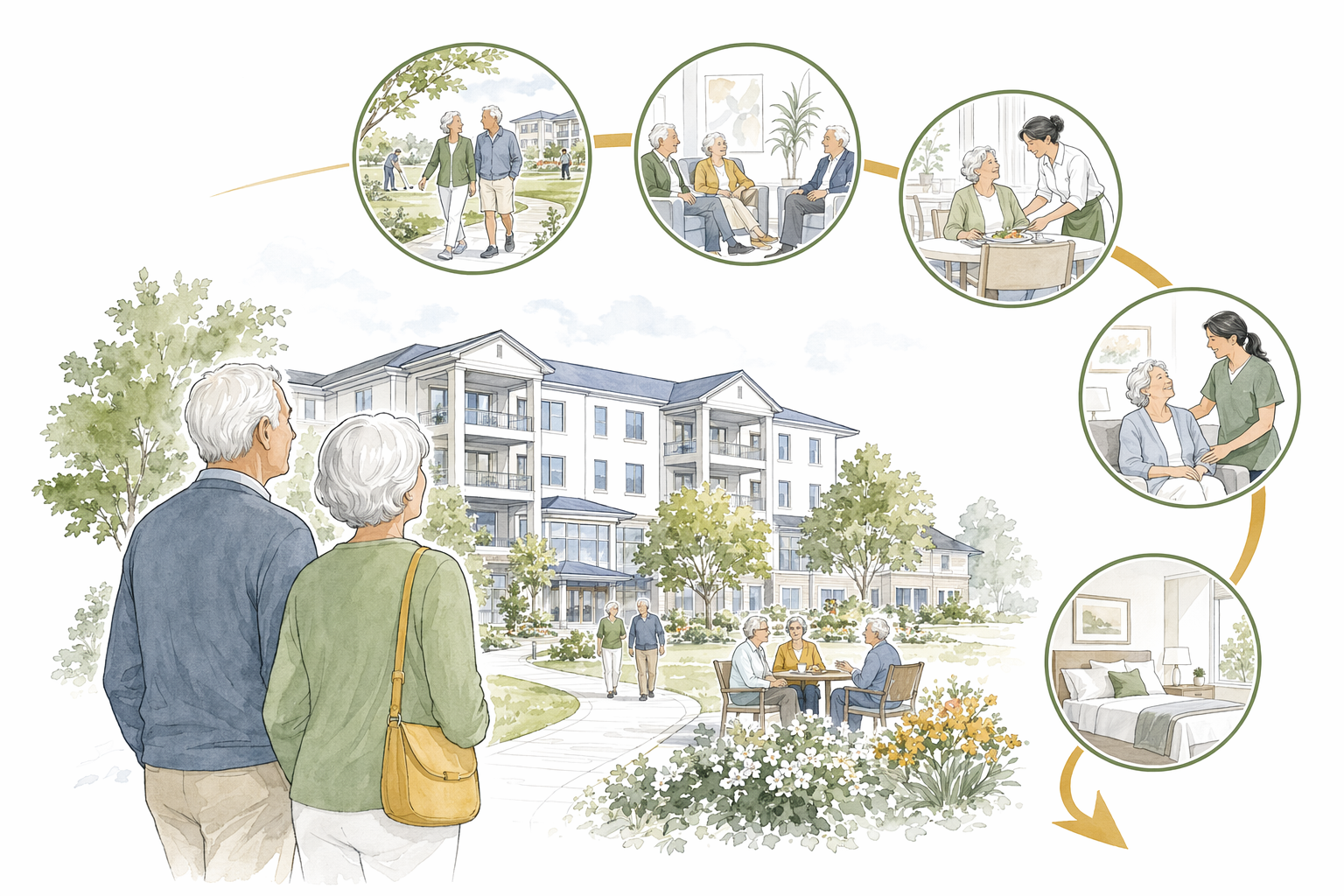
What a CCRC is, in plain language
A continuing-care community brings several types of senior living together on one campus or within one community. A parent may start in independent living, which usually means a private apartment or cottage, shared meals, activities, transportation options, and less home upkeep. If more help is wanted later, the same community may also offer assisted living, which adds support with everyday tasks like dressing, bathing, or medications.
Some CCRCs also include memory support or skilled nursing on site. The main idea is simple. Your parent can enjoy a social, maintenance-light lifestyle now, while knowing that more support may be available later in a familiar setting.
This is one option, not the only option. Many families care for a parent at home first, and that is deeply respected. A CCRC is simply a different path that some families like because it combines community life with longer-term planning.
- Several levels of living in one community
- Often starts with independent living
- May include assisted living and other support later
- Designed to offer continuity if needs change
Why some families choose a continuing-care community
For some older adults, the appeal is not just future planning. It is everyday life right now. A CCRC can mean neighbors nearby, meals together, activities, classes, walking paths, and fewer chores around the house. That can create more time for hobbies, friendships, family visits, and a comfortable routine.
Families often like the idea of staying in one community instead of making a new move every time life changes. If your mother or father enjoys settling into a place, getting to know staff and neighbors, and building a rhythm, that continuity can feel meaningful.
It can also help adult children feel more organized. Instead of searching from scratch later, the family has already chosen a community that may be able to meet different needs over time. That does not guarantee every outcome, but it is part of why CCRCs are worth understanding.
- A lifestyle with friends, meals, and activities
- Less home maintenance
- A familiar setting over time
- One community to explore for different stages
How a CCRC is different from other senior-living options
It helps to compare a CCRC with other choices. In independent living, a parent lives in a senior community with services and activities, but without daily personal help built into the apartment. In assisted living, the setting is similar, but with extra support for day-to-day tasks. A CCRC may include both, plus additional levels of support, all connected within one larger community.
That is what makes it different. It is not just one level of living. It is a community with a broader range of options under one umbrella.
If you want a simple overview of how these choices fit together, how senior living works is a good place to start. If you are still comparing possibilities, you can also explore senior living options in a broader way before deciding whether a CCRC feels like the right fit.
- Independent living is mainly lifestyle and convenience
- Assisted living adds help with daily routines
- A CCRC may offer multiple levels in one place
- Not every senior-living community is a CCRC
How pricing usually works
CCRC pricing can be more complex than pricing in other senior-living communities. Some have a larger one-time entrance fee along with a monthly fee. Others may have lower entrance costs or different contract structures. Monthly costs can still vary widely based on the city, the apartment size, the level of care, and what is included.
A broad monthly range might start around $2,500 to $6,500+ for independent living in some markets, while higher-cost cities and larger residences can be much more. Entrance fees, when they apply, can range from tens of thousands of dollars to several hundred thousand dollars or more. Assisted living or other added support within a CCRC may increase the monthly cost.
The most important thing to know is that there is no single national price. Ask what is included, how future support is priced, whether meals and transportation are part of the monthly rate, and what happens if a parent later wants a different apartment or level of living. Honest comparisons matter here.
- Costs vary by city, apartment, support level, and included services
- Some CCRCs charge an entrance fee plus a monthly fee
- Others use different contract and pricing models
- Always ask for a full written breakdown of what is included
Questions to ask when touring a CCRC
When you visit, try to picture your parent's real daily life there. Does the apartment feel comfortable? Do residents seem engaged? Are there activities that match your parent's interests, language, culture, and routine? A good tour is not just about the building. It is about whether your parent can imagine feeling at home.
It also helps to ask practical questions in plain language. What levels of living are on site? How does a resident move from independent living to assisted living if needed? Are there different contract types? What services are included each month, and what costs extra?
For many immigrant families, language and cultural comfort matter just as much as layout and price. Ask whether staff speak your family's language, whether there are familiar foods, and whether the community has residents from a range of backgrounds. These details can make a big difference in how welcome a parent feels.
- What levels of living are available here?
- How do costs change over time?
- What is included in the monthly fee?
- Are language and cultural preferences supported?
- Can your parent picture a happy daily life there?
How Willowbarrow can help
If the idea of a CCRC feels interesting but hard to sort through, Willowbarrow can help you compare options calmly. We are a free guide and matching service for families, not a senior-living provider. We help families understand the choices, narrow the search, and find communities that may fit their parent's preferences.
Many families come to us with simple questions first. What is the difference between independent living and assisted living? Is a CCRC worth looking at? What communities may be a match for my parent, in our language, in our area? We help you think it through, and your family stays in control of every decision.
If you want one-on-one help, you can get matched or visit our help center. Matching is always free for families, and many families can get support in their own language.
- Free guidance for families
- Help comparing CCRCs and other options
- Support in many languages
- Your family always chooses
A CCRC is a senior-living community where your parent can enjoy an independent, social life now, with more support possibly available later in the same place.
Common questions
Is a CCRC the same as assisted living?
No. Assisted living is one level of senior living that includes help with daily tasks. A CCRC is a broader community that may include independent living, assisted living, and sometimes additional support in one place.
Do you have to be sick to move to a continuing-care community?
Not at all. Many people move while they are active and independent because they like the lifestyle, community, and simpler day-to-day living. It is often a choice about how they want to live, not a medical decision.
Are CCRCs more expensive than other senior-living options?
Sometimes yes, especially if there is an entrance fee, but it depends on the contract, the city, the apartment, the level of living, and what is included. The best way to compare is to look at the full cost structure, not just one number.
Can my parent stay in the same community if needs change?
That is the main idea behind a CCRC. Many offer multiple levels of living in one community, though the exact options and availability vary by location. It is always smart to ask how transitions work and what is guaranteed in writing.